Why every K-drama Korean guide misses the one step that matters
Open any "learn Korean from K-dramas" post and you'll get four pieces of advice:
- Use dual subtitles.
- Pause and shadow.
- Pick beginner-friendly shows.
- Take notes on new vocabulary.
They're not wrong. They've been the same four pieces of advice for fifteen years and most of them have research behind them. But they're missing the one step that actually makes the words stick — and without it, you can do all four perfectly and still hit episode forty unable to recall what 답답하다 means.
The advice everyone gives
There's a reason every guide converges on the same tips: they're easy to teach. You can fit "use Korean subtitles" in a single sentence. You can post a YouTube short on shadowing. They're the visible part of language learning, the part you can describe in a thumbnail.
The four standard tips are good for one thing: making sure you're paying attention during the watch. They're an attention method. They're not a memory method, and conflating the two is how you end up at hour 200 wondering where it all went.
The step they all skip
Memory works by attaching new information to something specific. Cognitive scientists call this encoding specificity — what you remember depends heavily on the context you first encountered it in. The richer the context, the stickier the memory. This is why you can still picture the exact room where your best friend told you something important fifteen years ago, but can't remember a fact you read in a textbook last week.
When you write "정신 차려 = pull yourself together" in a notebook, you're stripping the context out. You've kept the word and thrown away every cue that would have helped you recall it. Two weeks later, when you see the phrase again, your brain has nothing to grab. So you re-look-it-up, file it on the same flat list, and the loop continues.
The fix isn't writing better notes. The fix is keeping the context.
Why the scene matters more than the word
The scene the line came from is the richest mnemonic cue your brain will ever get. The character's face. The room they were in. The emotional beat. The way the line was delivered. Throw all of that into one image, attach it to the card, and the word stops being floating data and starts being something you remember about something.
You can test this on yourself. Pick a Korean phrase you actually know from a K-drama. Try to recall where you first heard it — the show, the character, the scene. The fact that you can probably do that is the point. The memory of the word and the memory of the scene are stored together.
This is also why competing approaches that look similar — Anki decks of "Top 100 K-Drama Phrases," PDF vocabulary lists, browser plugins that highlight subtitles — keep failing the same way. They preserve the word but discard the scene. The card front is right; the card back is missing the cue that would make it stick.
What changes when the scene IS the card
The practical version: pause when a line lands, screenshot the moment, and put that screenshot on the back of the flashcard.
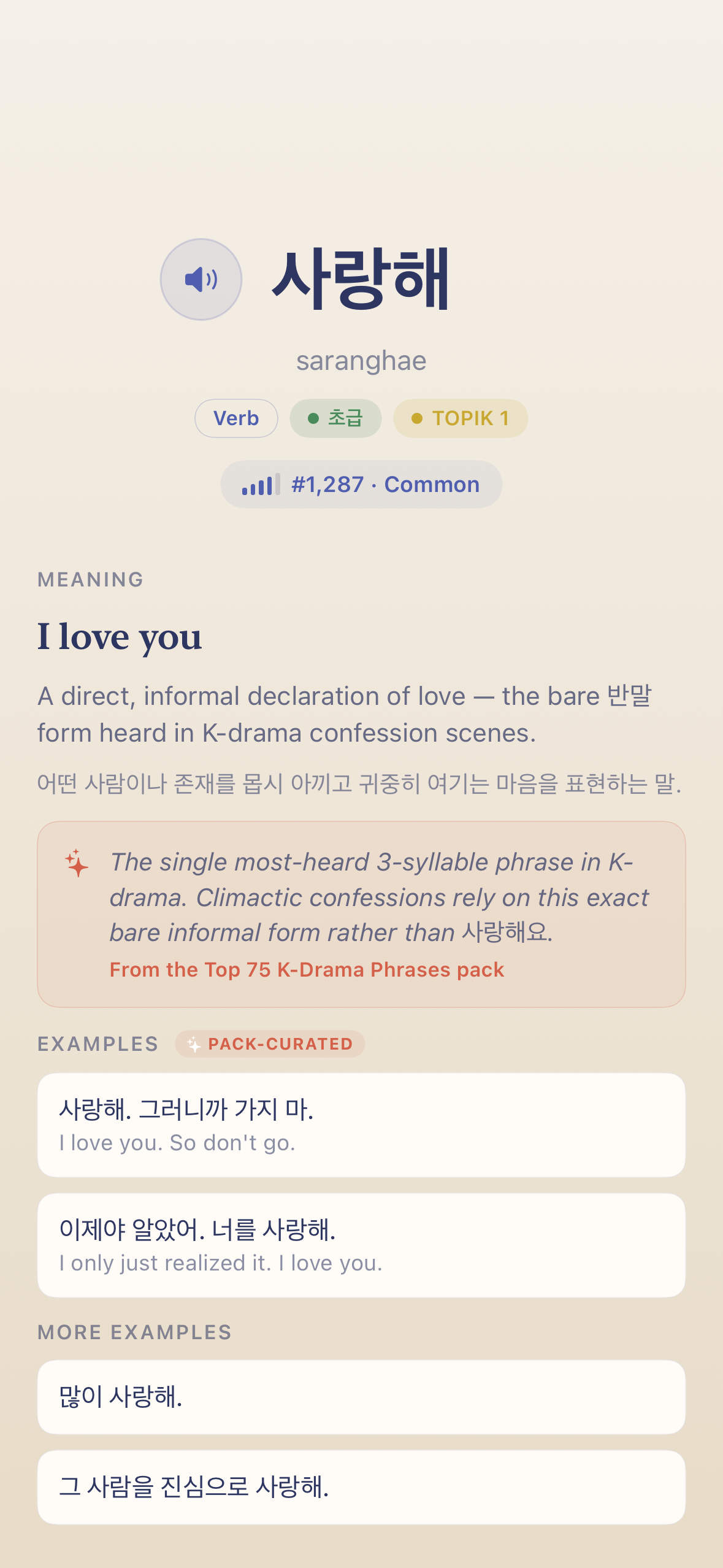
Front: the Korean, alone, the way you'll need to recall it.
Back: the translation, optional romanization, and — this is the part — the screenshot.
Now reviewing the card replays the scene. Two weeks later the photo surfaces before the meaning does, and the meaning follows through the scene, exactly like it did the first time you watched it. The forgetting curve, which was always going to win against flat lists, suddenly has competition.
The act of building the card matters too. Choosing the exact frame to capture — the one that holds the emotional beat — is itself a second encoding pass. By the time you've added the card you've already half-learned the phrase, before any review at all.
The honest catch
This is more work than writing in a notebook. The first card takes a minute. The first ten cards take a sitting. But it's the difference between vocabulary you almost-remember and vocabulary you actually own — and the per-word cost drops fast once you've done a few.
If you want to skip the setup, the Top 75 K-Drama Phrases pack inside Flipside ships with the most-repeated lines from the genre, already formatted scene-card-style, with the TOPIK 1 vocabulary method as the recommended pairing for the underlying grammar. Browse the Flipside dictionary if you'd rather pull words on-demand as you watch.
Dual subtitles, pause and shadow, beginner shows, take notes. They're all good advice. They're all incomplete.
The scene IS the card. Once you've used that, you won't go back.