Hangul Was Built in 1443 — and It's Perfect for Smartphones
You've seen it in a hundred behind-the-scenes clips: a Korean idol or actor thumb-typing a reply at a blur of speed. That speed isn't a quirk of modern phone design. It was built into the alphabet itself — in 1443, almost five centuries before the first touchscreen.
Every vowel is made of three pieces
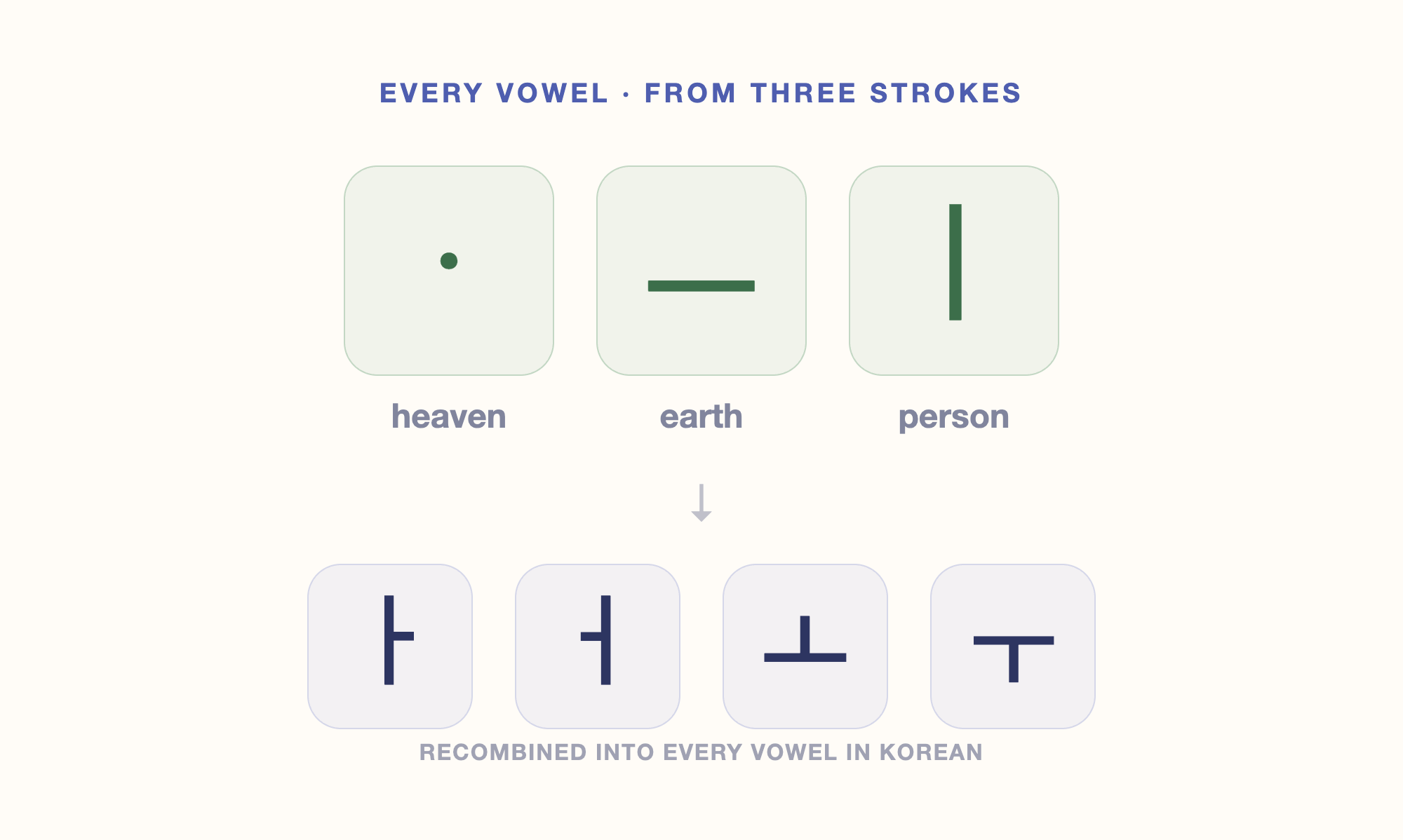
When King Sejong designed Hangul, he built all of its vowels from just three strokes, each with a meaning: a dot for heaven, a flat line for earth, an upright line for a person. (If you read why Hangul is the most scientific alphabet, you've already met them.) Every vowel in Korean is some combination of those three.
Which is exactly how you type them
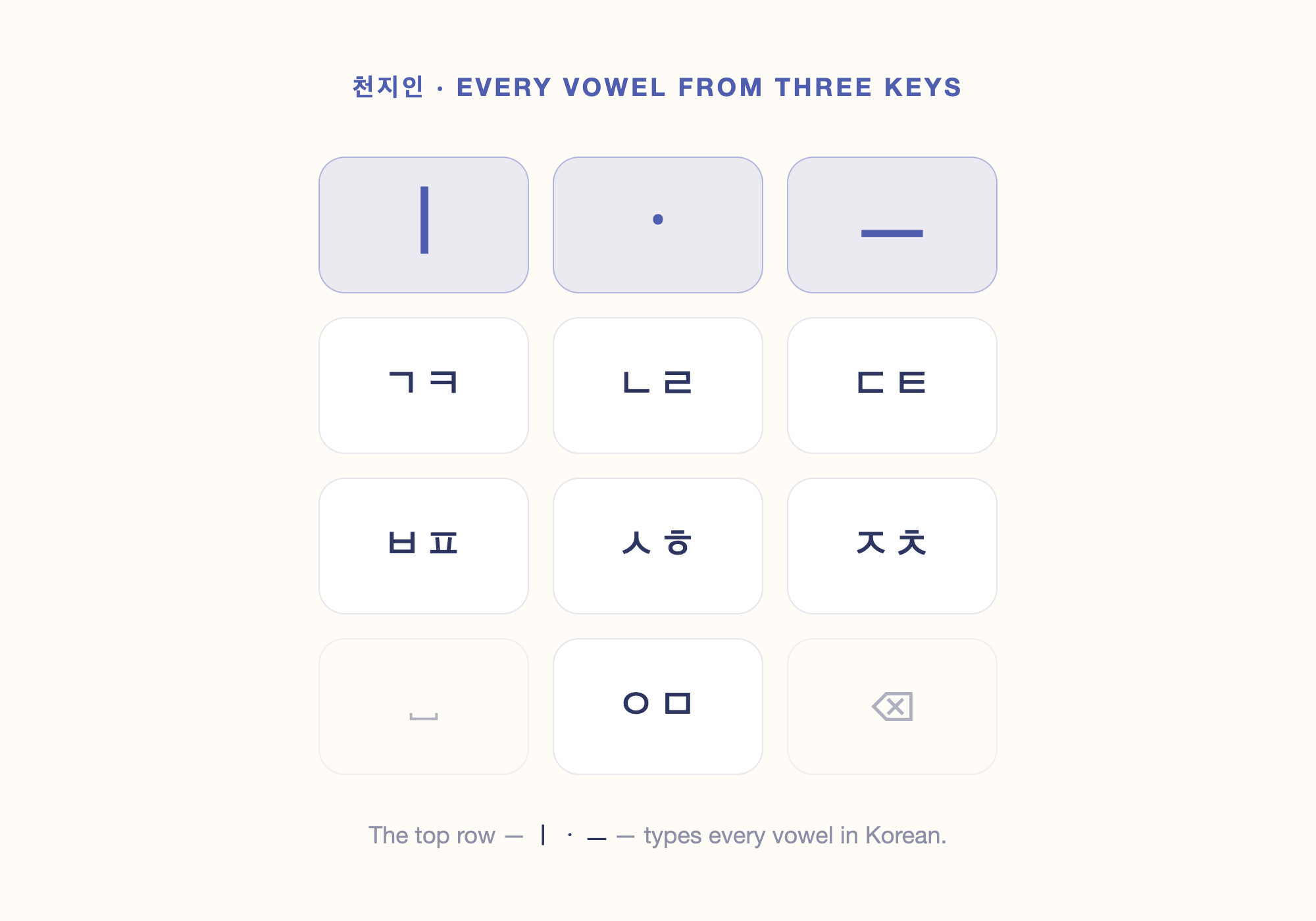
Now look at your phone. The most-used Korean keypad in the world is called 천지인 — literally "Heaven, Earth, Human." Samsung built it straight from Sejong's vowel theory: those same three strokes become three keys. No 26-letter QWERTY squeeze, no hunting — the entire vowel system lives on the top row.
Tap the strokes, get the letter
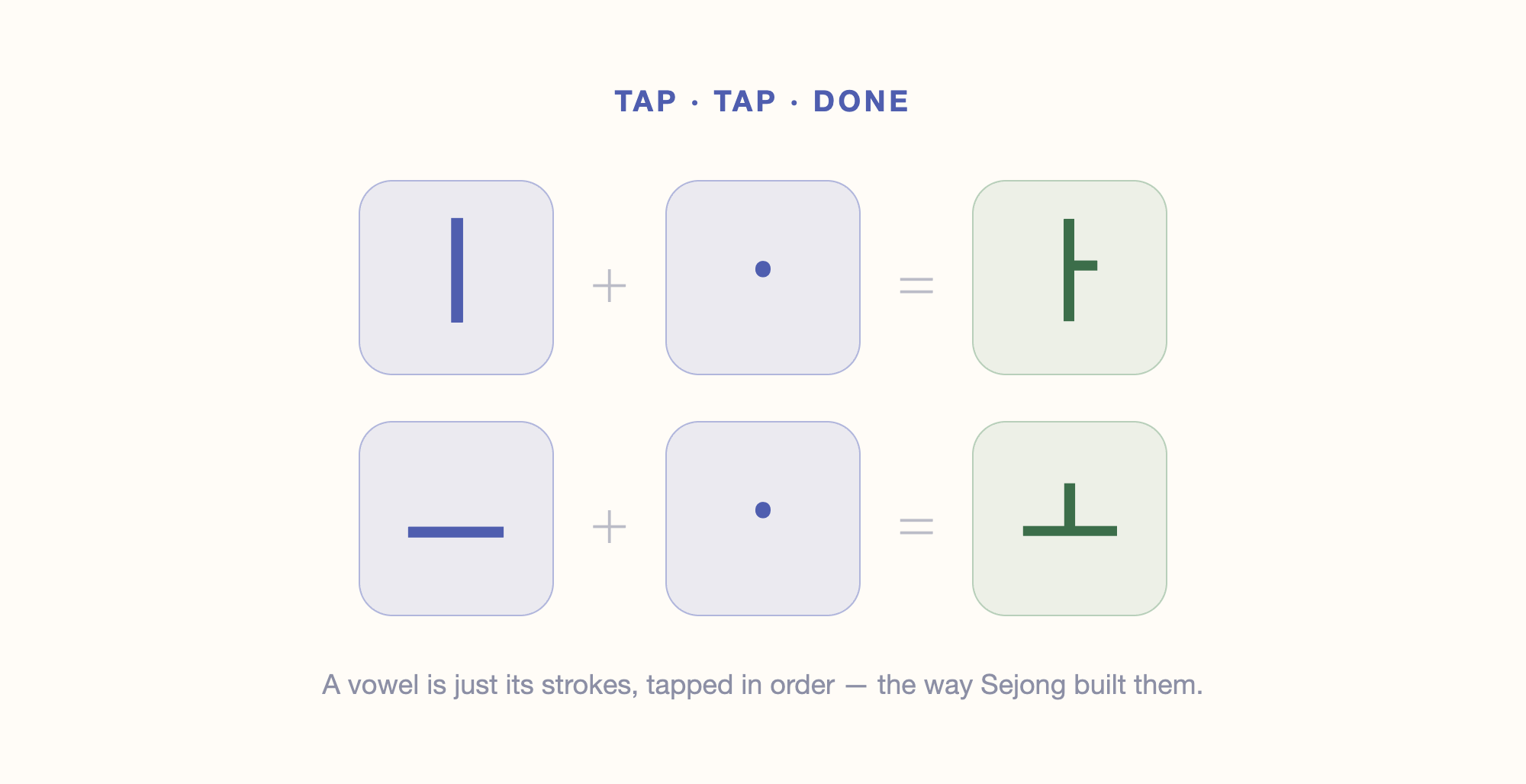
Typing a vowel is just tapping its pieces in order. Person + heaven gives you ㅏ. Earth + heaven gives you ㅗ. You're rebuilding Sejong's 15th-century logic with your thumb — and it takes two taps.
Sejong designed Hangul for clarity. He accidentally designed it for touchscreens.
Good enough to become a world standard
This isn't just a clever Samsung trick. In 2014 the 천지인 layout was adopted by the International Telecommunication Union as an official international standard (E.161) — the global reference for laying out a non-Latin script on a keypad. A design sketched by a 15th-century king is now the sanctioned way the world thumb-types Korean.
Nobody adapted it — it already fit
Here's the quietly amazing part: no one had to retrofit Hangul for phones. It already worked. An alphabet built so a farmer could learn it in a morning turned out to be built so anyone could type it in a tap — because both come from the same idea: make the writing match the logic of the sounds.
That's also the most rewarding way to learn it. Flipside's Read Hangul course teaches Hangul by that logic — the shape families, the three-stroke vowels, a native voice for every letter. Sound one out, drop it in the dictionary, and watch it click. Brand new to the script? Read Hangul in a weekend is the two-day plan.