10 K-drama phrases to learn — and how to make them stick
You've watched enough K-dramas to feel the language — the cadence of a confession, the exact beat before someone says "don't go." So you go looking for the K-drama phrases to learn first, and every guide hands you the same thing: a numbered list of 25, 28, sometimes 100 words. Three months later you couldn't repeat five of them. That's not a discipline problem. It's a format problem.
Why the lists don't stick
Search "K-drama phrases to learn" and you get a flat row of words, each with a romanization and a one-line gloss. 사랑해 — saranghae — "I love you." Next. The lists aren't wrong. They're just built to be read, not remembered — every cue that made the word memorable has been stripped out. (We took apart exactly why this fails in the one step every K-drama guide skips.)
The irony: you already met these words in the richest memory format there is — a scene, a face, an emotional beat. The listicle throws all of that away and hands you back the dry husk.
There's a sharper version of the problem, too. A list trains recognition at best — you'll nod along when 사랑해 floats past in the next episode. But recognition isn't recall. The moment you want to say one of these lines, or write it on a card from memory, a flat row of words gives you nothing to reach for. Recognition feels like progress and quietly isn't.
Pick 10, not 75
The second problem is volume. A 75-word pack or a 100-phrase listicle looks generous, but a wall of vocabulary is the fastest way to remember none of it. Ten is a number you can actually hold in your head this week — and ten high-frequency lines will carry you through more screen time than a hundred rare ones you'll never finish.
Ten isn't arbitrary. It's about the size of a set you can review in two minutes and actually finish — and finishing matters more than starting big. A handful you complete every day teaches more than a hundred you abandon at card nineteen.
So here are ten. Not the "most important" by some textbook ranking — the ten you'll hear in nearly every drama, grouped by the scene each one lives in. The scene is the point: it's the cue that makes the word stick.
The 10 K-drama phrases to learn, by scene
The confession
- 사랑해 (saranghae) — "I love you." The informal one — the one that actually gets said at 2 a.m. in the rain.
- 보고 싶어 (bogo sipeo) — "I miss you." Literally "I want to see you," which is somehow worse.
The goodbye
- 가지 마 (gaji ma) — "Don't go." The single most-replayed line in the genre. Grabbed wrist optional.
- 됐어 (dwaesseo) — "Forget it. / I'm done." What gets said right before someone walks out and immediately regrets it.
The "snap out of it"
- 정신 차려 (jeongsin charyeo) — "Pull yourself together." Delivered with a shoulder-shake to someone spiraling.
- 괜찮아 (gwaenchana) — "Are you okay?" The same two syllables are also the answer — 괜찮아, "I'm fine" (they are never fine).
The misunderstanding — the engine of every plot
- 답답해 (dapdaphae) — "I'm so frustrated / this is suffocating." The feeling of watching two people who just won't talk. (Dictionary form: 답답하다.)
- 오해야 (ohae-ya) — "It's a misunderstanding." The phrase that could've ended the drama in episode 4 if anyone had said it on time.
The reaction shots
- 대박 (daebak) — "Whoa. / No way. / Amazing." Works for a lottery win or a betrayal; tone does all the work.
- 진짜? (jinjja?) — "Really? / For real?" The universal beat right before any plot twist lands.
That's ten. Five scenes, two lines each — small enough to learn in a sitting, frequent enough to start hearing tonight.
Make the scene the card
Here's the method that turns this list into memory — and the whole reason to organize by scene. When a line lands in an episode, pause it. Screenshot the moment: the face, the room, the beat. Put the Korean alone on the front of a flashcard, and put that screenshot on the back next to the meaning.
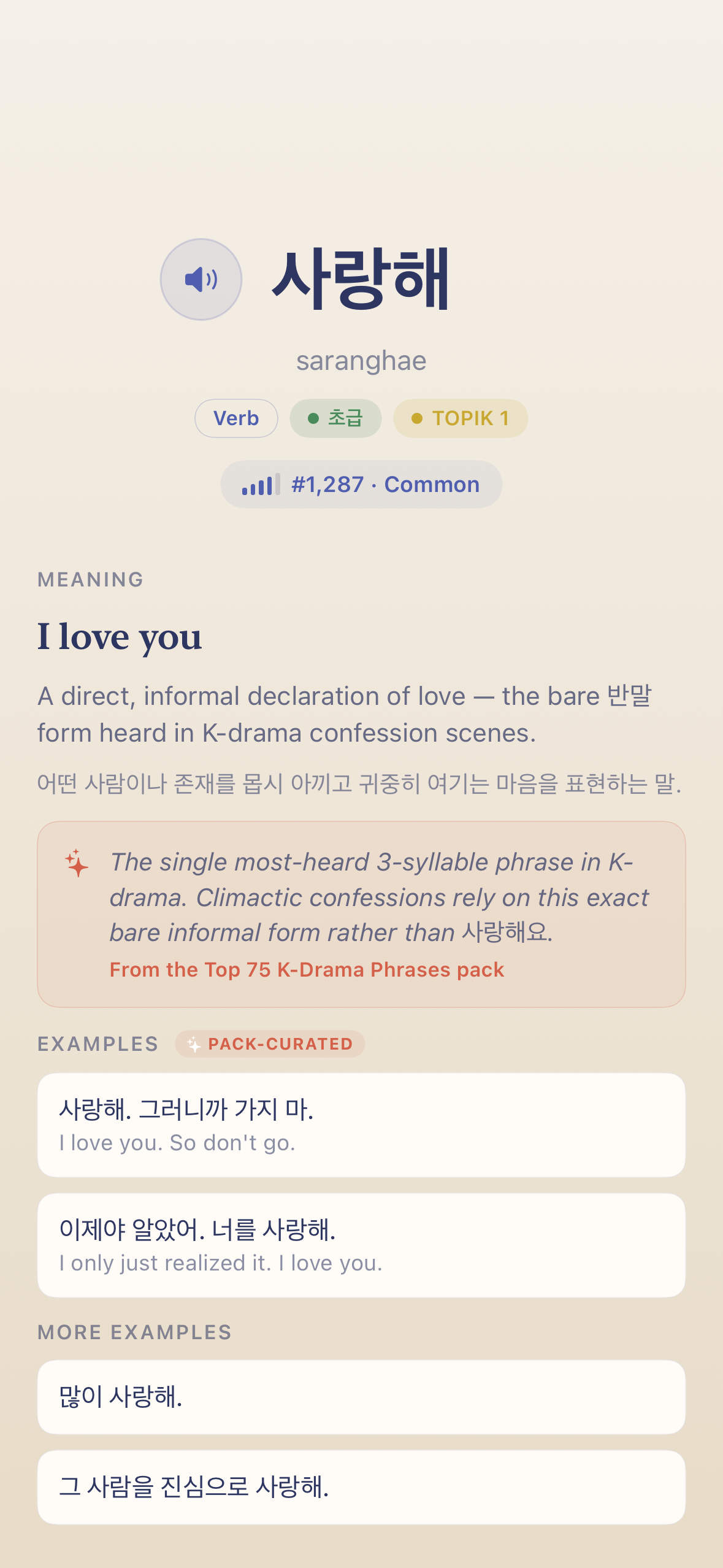
Now review isn't reading a row of words — it's replaying the scene. The photo surfaces first, the meaning follows through it, exactly the path your brain took the first time. Ten cards built this way beat a hundred typed into a list, every time.
The test: a week from now, picture the scene before you can picture the word. If the face comes back first and the meaning rides in behind it, the card did its job.
Where to go from here
If you'd rather not build all ten by hand, the Top 75 K-Drama Phrases pack inside Flipside ships these and the rest of the genre's most-repeated lines already formatted scene-card style — the full set, for when you're ready to go past ten. Pair it with the TOPIK vocabulary method for the grammar underneath, or browse the Flipside dictionary to pull any word on demand as you watch.
Ten phrases. Five scenes. The list was never the hard part — keeping the scene was.